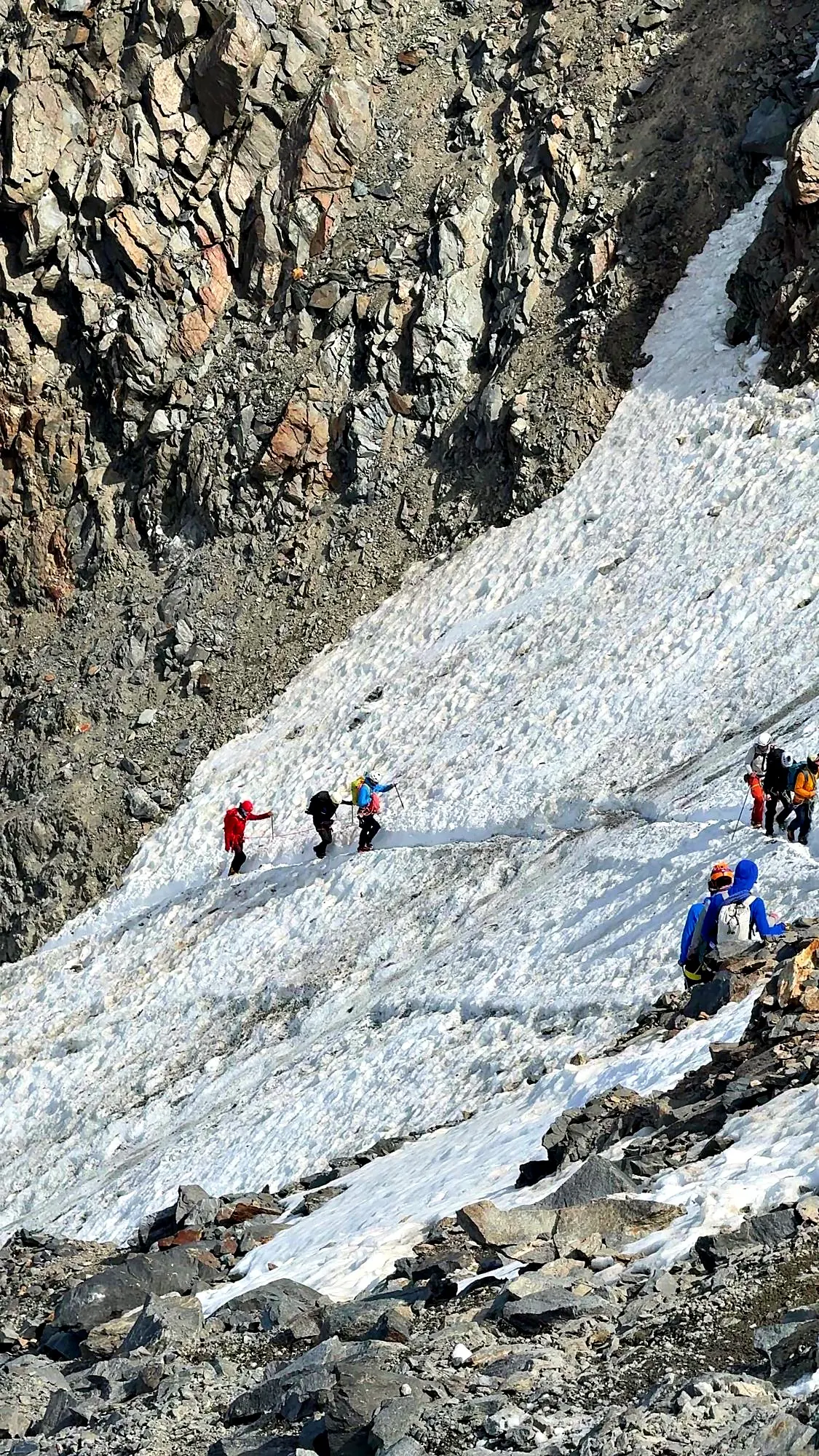
Mistakes are rarely spectacular. Instead of an avalanche or a storm it is more often a rucksack that is too heavy, too much food, a badly read email, no plan for the drivers or too much faith in an app.
Mistake 1: a rucksack that was too heavy
The rucksack weighed about 20.2 kg without water. Some of the weight was justified, some was excess. Next time I would cut comfort items and spare food harder.
A reserve is necessary, but you have to be able to justify every kilogram.
Mistake 2: too much food
We had too many freeze-dried meals and supplies. Staying in huts, a large part of the reserve was not needed. In the end the hut food worked well, and on the route the simple things mattered: bars, raisins, something easy to eat.
Emergency food yes, endless reserves no.
Mistake 3: too much electronics and too many power banks
Electronics were useful, but it is easy to overdo. A phone, a watch and a camera make sense. Several power banks “just in case” start to weigh. On top of that came mobile data spent on sending videos and, most likely, on automatic photo syncing with iCloud and Google Photos.
Better to switch off photo syncing over mobile data, keep maps and documents offline and carry a sensible energy reserve than take all the electronics from home.
Mistake 4: too little lip protection
At altitude, with sun, wind and snow, your lips take a beating very quickly. It is a small thing that is easy to forget and then bothers you for the whole trip.
Lip balm with sun protection belongs in your pocket, not somewhere deep in the rucksack.
Mistake 5: too much faith in an app
On the Bellevue to Tête Rousse section the map did not always lead the obvious way. We had to look at the terrain, tracks, the railway, people and conditions. An app is a tool, but it does not replace judging the situation.
A GPS track helps, but your eyes and head matter more.
Mistake 6: a mistake with the car
I describe the mix-up with the car in the ebook. One email not followed up, an unclear pick-up point or rental terms are enough.
I now confirm the car as carefully as a hut: place, time, documents, deposit, drivers and travel abroad.
Mistake 7: no proper plan for resting after the descent
The drive back home after that kind of effort is a separate risk. I drove most of the way. Next time I would plan the drivers and rest better.
The trip ends when you are safely home, not when you ride the gondola down.
Mistake 8: too little casual video footage
I had plenty of beautiful shots, but after the trip I felt I needed more short handheld clips: packing, chaos in the hut, fatigue, conversations, details of the route. They show the practical side of the trip best.
If you plan an ebook, a film or teaching material later, film what happens between the views too.
Mistake 9: testing some gear setups too late
Some things have to be checked earlier: how the rope is attached, access to food, how gloves work, packing for the summit, handling gear in the cold.
Critical things are tested at home, not at three in the morning at the Goûter.
Mistake 10: summit pressure
Sometimes what is in your head is harder than your legs. Cost, preparation, time off work, bookings and the dream of the summit build pressure.
Give yourself permission to turn back at home, before turning back becomes necessary in the mountains.
Mistake 11: going without seeing a cardiologist
If you have had serious health problems, see a doctor before the trip, even if you are afraid of what you will hear. Better to learn about the risk in a consulting room than at altitude.
Plan B
A plan B protects your head, your logistics and your safety. It has nothing to do with lack of ambition. If you travel from far away and pay for huts, a car, fuel and insurance and take time off, you naturally want to reach the top. But the mountains have no duty to let us onto the summit.
Before the trip it is worth answering a few questions:
- What do we do if the weather does not allow a start?
- Do we have a spare day?
- Can we move the plan?
- Do we have other objectives nearby?
- Do we stay in Chamonix and wait?
- Do we do an easier route?
- Do we go home early?
- Does the group see not reaching the summit as a failure or as part of the risk?
The worst plan B is the one you do not have. Then in bad weather the thinking starts: since we are here, since we have spent the money, since we have a booking, maybe we should try after all. That is how most bad decisions in the mountains begin.
A plan B does not take away motivation or the dream. It takes away the pressure that the only acceptable version of the trip is reaching the summit.
What I would do the same way
Not everything was a mistake. A few things I would repeat without hesitation:
- Looking for a team early
- A joint test trip
- Gran Paradiso for acclimatisation
- Two nights at the Goûter
- The van as a logistics base
- Keeping documents offline
- Checking the weather from several sources
- The approach: safety before the summit