Hut reservations were the backbone of the whole trip. On the normal route via the Goûter you cannot plan around your dream summit date alone. First you check whether there are any places in the huts at all. Only then can you fit in acclimatisation, transport, time off work, valley accommodation and the budget.
It was one of the first things that showed us Mont Blanc is a logistics project. You can have the fitness, the gear and the motivation, but without a bed in the right place the whole plan falls apart.
What we booked first
We booked the Goûter first. It was the most important part of the plan, because the summit day depended on it. Without the Goûter the normal route via Tête Rousse and the Goûter loses its logic or becomes much harder to organise.
We managed to get two nights at the Goûter: 12 and 13 June. That immediately reshaped the plan. Only after the Goûter did we book Tête Rousse for 11 June, so that the climb to the Goûter the next day made sense.
Bookings on the normal route go through a single FFCAM system (montblanc.ffcam.fr), introduced by decision of the prefect. You enter the details of every member of the party and upload a scan of each person's ID: identity card, passport or driving licence. First you make a provisional booking, which the FFCAM operator confirms by email. From then on you have 48 hours to finalise it and pay the deposit, otherwise the booking lapses. Book Tête Rousse and the Goûter in one basket, because the booking fee (€5) is charged per basket. One booking covers at most 12 people, and reselling bookings is not allowed. Those were the rules in 2026. Check them again before you book.
So the booking order looked like this:
| Step | What we booked | Why |
|---|---|---|
| 1 | Goûter | the key point of the plan, the summit day depended on it |
| 2 | Tête Rousse | fitted to the Goûter dates |
| 3 | acclimatisation | fitted to the Mont Blanc dates |
| 4 | Rifugio Vittorio Emanuele II | after deciding on Gran Paradiso |
| 5 | transport and valley accommodation | planned around the confirmed hut dates |
On Mont Blanc, planning often starts with the question “when are there beds at the Goûter?” and only then “when do I want to go?”.
Tête Rousse and the Goûter
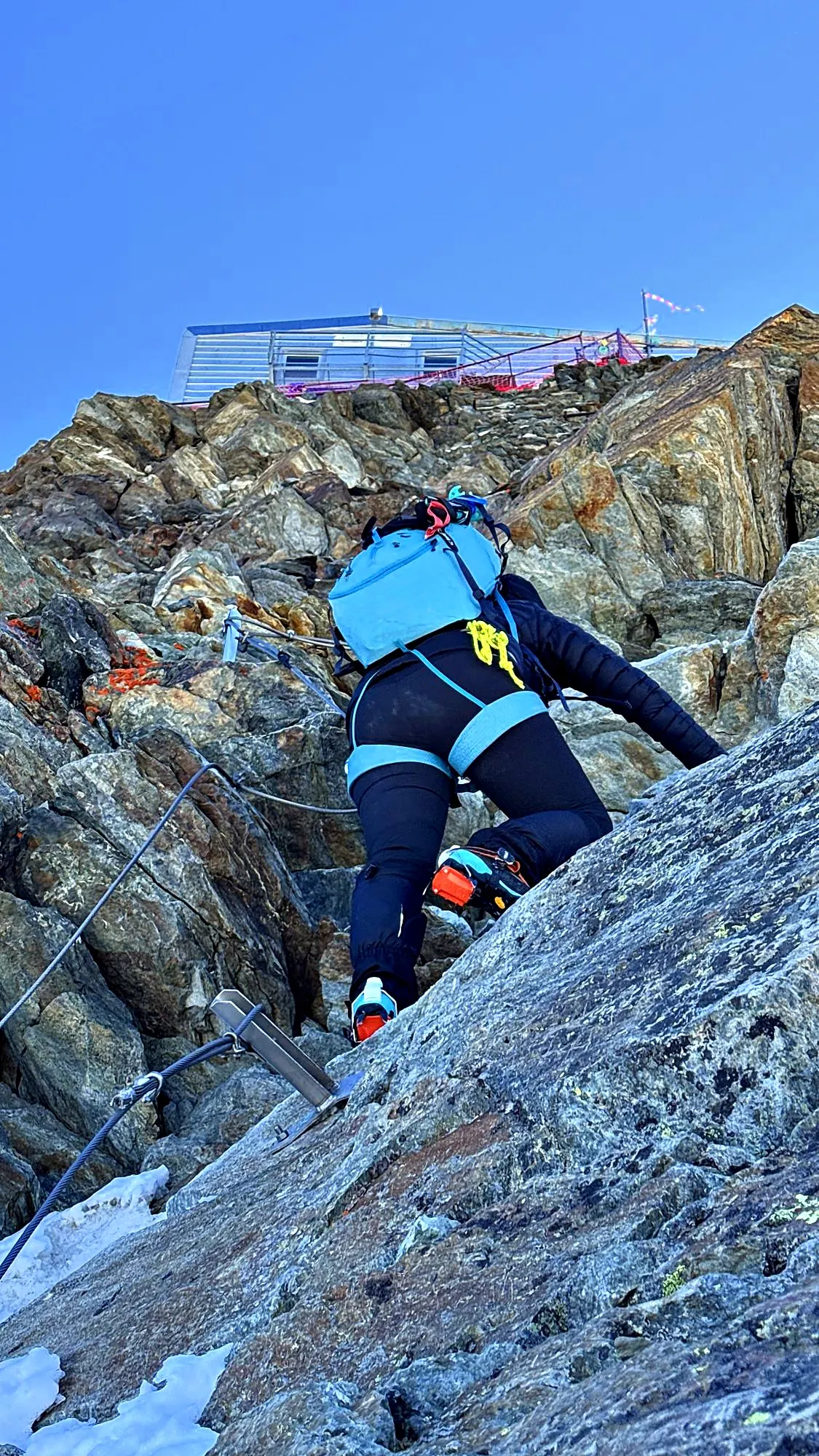
Tête Rousse and the Goûter play different roles. Tête Rousse is the lower hut, before the harder part of the route. You reach it after a long day from Bellevue or the Nid d’Aigle, and you rest there before crossing the Grand Couloir and climbing the rocks of the Aiguille du Goûter.
The Goûter is the base right below the summit. Here everything gets real: packing for the night start, breakfast around two, leaving in the dark, altitude, wind, the Vallot, the Bosses ridge and the summit.
We had Tête Rousse on 11 June and the Goûter on 12 and 13 June. Two nights at the Goûter mattered a lot to us, because we could return to the same hut after the summit. We did not have to descend straight away through the Aiguille du Goûter and the Grand Couloir to Tête Rousse. That took pressure off, although of course it cost more.
A second night at the Goûter as a buffer
A second night at the Goûter is more than comfort. It is a safety buffer. You can come back to the same place after the summit, rest, descend more calmly the next day and feel less pressure to get down the whole difficult section right after the top.
The buffer also matters when conditions force you to change the plan. If weather, wind, snowfall or the team's pace delay things, an extra night at the Goûter gives you more room to decide. You still cannot ignore time and conditions, but the plan no longer hangs on one perfect scenario.
If your budget and the availability allow it, a second night at the Goûter may be one of the most sensible logistical decisions. The point is spare time, and the comfort is a side effect.
Deposits, balances and receipts
Watch the costs closely when booking. Part is paid in advance as a deposit, part later on site. On top of that come meals, water, drinks and fees. It is easy to count something twice, or to miss that a hut receipt does not show the full cost of the night, only the balance and the food.
So for every booking, write down:
- The full price
- How much deposit was paid
- How much is left to pay
- What the price includes
- Whether meals are included
- Whether water costs extra
- Whether you need your own sleeping liner
- The cancellation terms
- The latest arrival time
- Which documents may be checked
Here is our breakdown per person as an example. At Tête Rousse I had dinner and breakfast, at the Goûter two dinners and two breakfasts: before the summit and the morning after. The booking price did not include food, so we paid for meals and the rest of the night on site, in cash.
Tête Rousse: €40 deposit by bank transfer and €83 on site (balance for the night €15.80, dinner and breakfast €67.20), €123 in total,
Goûter, first night: €50 deposit and €89 on site (balance for the night €15.80, dinner and breakfast €73.20),
Goûter, second night: €50 deposit and €94 on site (balance for the night €20.80, dinner €52.20, breakfast €21),
Rifugio Vittorio Emanuele II: about €90 with meals (an estimate, no receipt).
That adds up to about €496. It is not everything we spent in the huts, though. There was also water, drinks and, after coming down from the summit, beer. I do not have receipts for all of that, so it is not included. The second night at the Goûter came out €5 more expensive because the balance for the night was charged at a higher rate. These are June 2026 amounts, not a current price list.
In the final budget you cannot put everything in one bucket. Count Tête Rousse, the Goûter and Vittorio separately, splitting deposits, balances and spending on site.
Checks and documents
On the normal route via the Goûter you should expect bookings and documents to be checked. That is ordinary logistics. When huts are booked by name and access to the route is regulated, your confirmations must be available offline.
Read the whole confirmation email too, including the small print. Our Tête Rousse email clearly said to print the voucher and carry it: the booking may be checked during a police check on the normal route and at the hut entrance, together with your ID. It also said that after 17:00 the booking may become invalid if we do not contact the hut. If you are slower, the weather turns or you are delayed, you need the hut's number and you must call before that time. The same email said that food and the tourist tax are paid on site, and that for hygiene reasons your own sleeping liner is compulsory (the hut sells them for €10).
My rule: everything important must be available without internet. Screenshots, PDFs, printouts or an offline folder on your phone.
Booking checks can happen
On the normal route, assume that confirmations may be checked not only at the hut. A check can happen at the starting point or on the approach, especially in season when traffic on the route is regulated. So your confirmations cannot just be “somewhere in an email”.
The safest is to have them in several forms: offline on your phone, in a folder shared with the team and on paper at least once. Then no signal or a flat phone will not stop you on the trail.
What I would do next time
Next time I would start with one booking table. Instead of loose emails and links scattered across the group chat, a simple spreadsheet: hut, date, number of people, cost, deposit, balance, who paid, booking number, latest arrival time and what you need to carry.
It sounds like office work, but it really calms the head. When you are driving through several countries, climbing Gran Paradiso on the way, then repacking and walking up to Tête Rousse, you do not want to dig through emails to see what has been paid and whether anything is still owed.