Acclimatisation
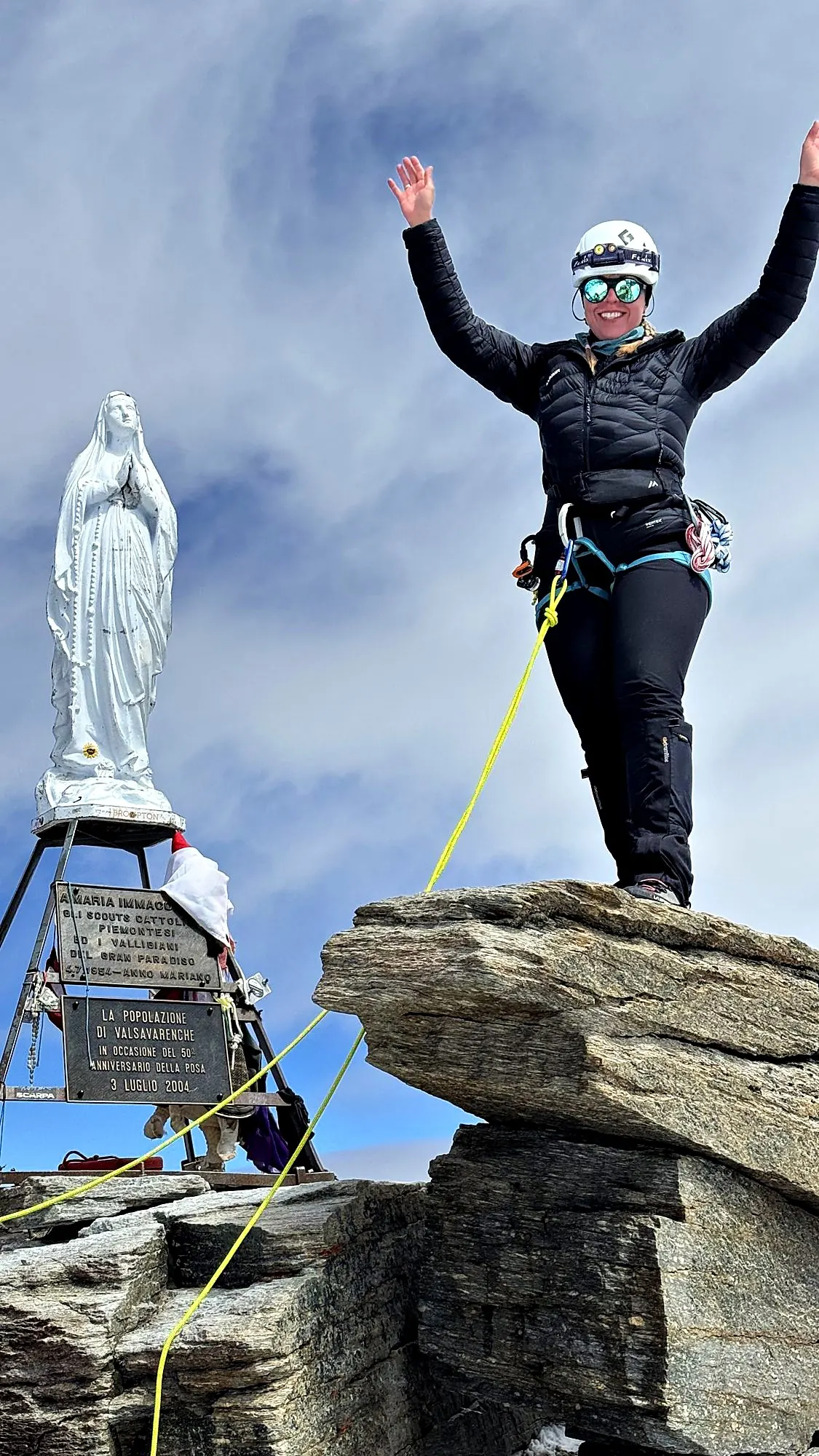
Gran Paradiso was the core of our acclimatisation. We chose it because it is high, logistically well placed for Mont Blanc and takes you above 4,000 m. It is not an acclimatisation stroll, though. It is a full mountain day, with a long climb, a glacier, altitude and a demanding finish.
Other acclimatisation options
We chose Gran Paradiso, but there are more options. Other teams pick, for example, the Allalinhorn near Saas-Fee, the Breithorn near Zermatt, the Aiguille du Midi or other Alpine objectives, depending on dates, weather, transport and experience.
I would not call any of these options the best for everyone. Each has different logistics, cost, risk and demands. For us Gran Paradiso made sense, because it took us above 4,000 m and fitted with the onward drive to Mont Blanc. Someone else may plan it completely differently.
Instead of asking which four-thousander is the easiest, check whether an option really helps with acclimatisation, does not drain too much energy and fits the logistics of the whole trip.
Acclimatisation is there to test your body, your gear, your team and your reaction to altitude before you stand below the Goûter. For me Gran Paradiso was an important test.
The final rocky, exposed section to the very top requires experience with exposure and climbing gear. Below the rocks we roped up. Nothing on the normal route up Mont Blanc is as technical as that finish. If you do not feel confident, you do not have to go to the very top: for acclimatisation it is enough to spend time high up, below the summit. If you have the experience, the reward is a beautiful view, including Mont Blanc, the goal of the whole trip.
After Gran Paradiso I thought I was the weakest in the team and probably would not make it. I came up last and I was very tired. Then each stage went better: I handled the altitude well, recovered quickly, and at the Vallot it turned out that in those conditions I was coping better than many others. A weaker acclimatisation day does not decide the outcome, but it is worth thinking it through honestly.
Acclimatisation gives no guarantee. You can feel good on Gran Paradiso and worse on Mont Blanc. You can have a great acclimatisation day and a weaker summit day. But without acclimatisation the risk goes up. I would not underestimate the altitude on Mont Blanc just because many people climb it.
Safety: altitude sickness
Above roughly 2,500 m the body gets less oxygen and some people start to cope badly with altitude. Altitude sickness can affect anyone, and good fitness does not protect you from it.
Symptoms of acute mountain sickness:
- Headache, often the first symptom
- Nausea, vomiting, loss of appetite
- Weakness and fatigue beyond what the effort explains
- Dizziness
- Trouble sleeping
- Life-threatening symptoms:
- Cerebral oedema (HACE): loss of balance, unsteady walk, confusion, unusual behaviour, drowsiness
- Pulmonary oedema (HAPE): breathlessness at rest, cough, sometimes with frothy or pink sputum, a sudden drop in performance, blue lips
A simple balance test: a few steps along a line, placing the heel right in front of the toes of the other foot. If someone sways or cannot do it, take it very seriously.
Rules:
- Do not go higher if you have symptoms of altitude sickness
- If symptoms do not ease with rest or get worse, go down
- With signs of cerebral or pulmonary oedema, descend immediately, even at night, and call for help
- A person with symptoms never descends alone
- Acclimatise gradually: go high beforehand (for us that was Gran Paradiso) and do not sleep much higher than the night before
- Walk at your own pace, not the pace of the fastest person in the team
- Drink regularly and eat, even without appetite
- No alcohol and no sleeping pills before the summit day
- Do not hide symptoms from the team and watch the others
- Use altitude sickness medication only after consulting a doctor; it does not replace descending
Not every headache at altitude means altitude sickness. After the summit mine turned out to be caused by a helmet that was too tight (I write about it in the ebook). Make that judgement carefully, though, and only once altitude can be ruled out. I am not a doctor. These are basic rules worth knowing before you go.
Mental preparation
Sometimes the head is harder than fitness. Mont Blanc plays on ambition. It is the highest peak in the Alps. There is a lot of preparation, a lot of cost, a lot of talk and a lot of expectation. Once you are in the hut, it is easy to feel you have to try at all costs.
That is why mental preparation also means preparing to turn back. Tell yourself and your team in advance that not reaching the summit is not a failure. Failure would be ignoring the conditions, hiding symptoms, pushing on at any cost or pretending there is no problem.